Best Soft Coolers of 2026
Cooler bags, insulated totes, cooler backpacks, and soft shell coolers ranked for ice retention, zippers, and portability

August 25th, 2025, updated with a new overall and new winners in almost every category, 5 new coolers tested, and how to choose section
Home > Gear Reviews > Camping
We've spent the past 4 years field testing soft-sided coolers across diverse outdoor environments from lakes in Maine to road trips in Arizona. We've evaluated performance factors like ice retention, leakproof reliability, portability, and durability under real-world testing. Our testing methods included everything from side-by-side comparisons during picnics, rafting trips on Maine's Saco River, camping expeditions to Pinnacles and Mojave National Parks, road trips across multiple states, and beach outings from New Hampshire to the Pacific coast. This meant we really got to test each cooler's performance across temperature extremes!
Our "lab" testing included ice retention trials over 20+ hours in direct sunlight and 90+ degree temperatures. We also ran tests for leaks, including upside-down shake tests and looking for leaks with prolonged storage. We ran portability tests by carrying each cooler different distances with different sized people. To test durability, these coolers were exposed to sand, silt, water, pine needles, and rough handling. Testing protocols prioritized coolers that did well across all our testing criteria including soft coolers with reliable waterproof zippers, excellent insulation, comfortable straps for longer carries, strap and a durable design that doesn't degrade with UV exposure.
We also give you a value proposition analysis that balances features against cost because soft coolers are an investment. We do that by incorporating different testers' feedback over 4 years' worth of long-term durability testing across multiple seasons. Lastly, we take into account specific use cases for these coolers, from lunch transport to multi-day rafting trips, to find the best value for what you do.
Our top choice: The Yeti Hopper Flip Soft Cooler delivers the optimal combination of superior ice retention, durable construction, and versatile portability features. It's an investment, but it is the best soft cooler overall for anyone who spends time outdoors and away from their refrigeration who wants reliable cooling in a no fuss, leakproof design.
This guide presents our findings on the top-performing soft coolers that demonstrated exceptional ice retention, leak-resistant design, and durable construction for keeping food and beverages cold during outdoor adventures.
If you’re looking for more storage or want to keep your items cold for longer than a day or two, you might want to check out a hard cooler.
We create reader-supported, objective gear reviews independently selected by our editors. This story may contain affiliate links, which help fund our website. When you click on the links to purchase gear, we may get a commission — without costing you an extra cent. Thank you for supporting our work and mission of outdoor coverage for every body! Learn more.
Comparison Table
| SOFT COOLER | TREELINE AWARD | COOLER TYPE | CAPACITIES AVAILABLE (L) | CANS IT CAN FIT | WEIGHT (LBS) | MSRP* |
|---|---|---|---|---|---|---|
| Yeti Hopper FlipCooler | Best Overall Read why |
Rectangular | 8, 12, 18 L | 13 | 3.1 | $250 |
| YETI M20 2.0 Backpack Soft Cooler | Best Backpack Cooler Read why |
Backpack | 12, 20 L | 36 | 5.6 | $325 |
| YETI Hopper M30 2.0 Soft Cooler | Best Insulater Cooler Bag Read why |
Rectangular | 15, 30L | 42 | 7.0 | $350 |
| REI Campwell 18L Folding Cooler | Best Everyday Cooler Read why |
Tote, cube, or flat | 8, 18 L | 12 | 1.1 | $40 |
| REI Trailgate 30L Weekend Cooler | Best Budget Read why |
Rectangular | 20, 30 L | 24 | 5.9 | $160 |
| RTIC Soft Pack 30 Can | Best for Road Trips Read why |
Rectangular | 12, 18, 20, 40 cans | 30 | 4.0 | $130 |
| Coleman Chiller 16-Can Soft Cooler | Best Insulated Lunch Bag Read why |
Lunch Box | 9, 30 cans | 16 | 1.5 | $33 |
The Best Soft Coolers
Best Overall: Yeti Hopper Flip

Cooler type: Semi-rigid soft cooler
Capacity: 12 cans
Other capacities available: 8, 18 cans
What we like: Extremely durable, easy to use, great insulation, tons of handles, convenient size
What we didn't like: Very expensive, no extra pockets, flips upside down easily
Of all coolers we tested, the Yeti Hopper Flip 12 was one of the best with ice retention, easiest to transport, the most durable (especially with gritty sand in that burly zipper), and one of the best leakproof coolers we used. The Yeti Hopper balanced all the criteria we were looking for in a soft cooler, scoring our top award for Best Soft Cooler.
The Hopper Flip is a durable, hardy-built soft-sided cooler — if your budget can handle it. If it can? Snag one, fill it up, and head to your nearest hangout. You won’t regret it.
See our in-depth review of the YETI Hopper Flip soft cooler for more details.
Compare Prices Of The Yeti Hopper Flip


-
We were thrilled with how the Yeti Hopper Flip performed. Even in direct sunlight in 90+ degree weather during our retention test, the Hopper Flip 12 held onto its ice — about 50% of the cubes were intact after 20+ hours in the sun.
This waterproof cooler performed well for the testers who took it out on the Saco River that runs through Conway, NH, and Fryeburg, ME. It kept the heat out and the cool in, without letting river water invade the scrumptious contents within. It also survived a few curious nibbling dogs; almost floating downstream once or twice; and even kept out bugs, rocks, and sand after a tumble off of a tailgate.
-
We tested the Hopper 12 and Hopper 18. We found the Hopper 12 cooler was the perfect size and design for overnight trips and long beach days — whether on the shores of the Saco River in New Hampshire or on the sands of York Beach in Maine. The 18 was great for 3-day trips for two people at Pinnacles National Park, Mojave National Park, Anza Borrego Desert and camping along the Kern River in the southern Sierra.
We've also used the Yeti Hopper extensively for grocery runs. Living in small mountain towns, we often find ourselves stocking up in bigger cities that are hours away from home base. The Yeti Hopper kept our ice cream and produce cool in the back of a hot vehicle.
The Yeti Hopper is available in 8, 12, and 18, so you have some flexibility depending on how many people are going on your trip and what you're bringing.
-
The cross-body removable shoulder strap made it easy to carry across the sand and through the parking lot with a few towels piled on top, but the top handle made it easy to pick up from a truck bed and walk down a few dozen feet to the river bank, too. (There are also smaller handles on the front and back for even more portability options.)
The ability to remove the cross-body strap was much appreciated, as were the extra gear loops on both the front and the back, which made it easy to clip accessories and strap the soft-sided cooler into different boats when needed.
-
The burly Hydrolok zipper was the reviewers’ biggest gripe.
The pros? This zipper is tough enough to take on sands from coast to coast (when tested, sand in no way affected the zipper’s ability to close and stay closed, unlike other, smaller zippers like the Coleman soft cooler we recommend) without breaking. It’s also leakproof, so no water will escape even if your cooler tips over in the car. (This came in handy at the end of a long afternoon when supplies were haphazardly piled in the back seat of a vehicle, and even tipping over didn’t spill the icy contents.)
The downside to this hefty zipper? It can be a beast to zip/unzip and nigh impossible one-handed. (Which is why we liked the OtterBox Trooper and the Yeti Hopper M30 so much — they’re easily opened and closed with one hand.) The Hopper Flip comes with a Chapstick-like zipper lube tube, making it easier to zip and keeping the zipper in better shape to last longer. We found that working the lubricant into the teeth did help with slightly easier sliding, but the Hopper Flip is nearly childproof when using that zipper.
-
Both personally and across the board, as I researched and meta-reviewed for the Yeti Hopper Flip, the price-point for Yetis has overwhelmingly been the most significant gripe.
Best Backpack Cooler: YETI M20 2.0 Backpack Soft Cooler

Cooler type: Backpack
Capacity: 36 cans
Other capacities available: 12, 20 L
What we like: Durable design, comfortable to carry when full, good capacity
What we didn't like: Expensive
As outdoor enthusiasts, we love versatile gear pieces. So when it comes to a soft cooler that doubles as a backpack and a dry bag? Sign us up!
But to ensure we weren’t just jumping into a gimmick, we scoured reviews from the past 5 years and spoke to folks who owned and used their YETI M20 backpack coolers. The results were nearly unanimous — when it comes to a backpack cooler, the YETI M20 2.0 Backpack Soft Cooler was a clear winner. Learn more in our in-depth review of the YETI Hopper M20 2.0 Backpack Soft Cooler.
Compare Prices Of YETI M20 2.0 Backpack Soft Cooler


-
Rather than a rugged zipper or a flip-top lid like other models, the YETI M20 2.0 backpack soft cooler uses a roll-top design to keep the contents water-tight, just like many popular dry bags. Although some users commented that the roll-top was stiff and difficult to use at first, they eased up once the fabric broke in. Be prepared to reach for your beverages, though — the roll-top takes up inches, so you’ll reach further down and into the cooler bag than it might seem when rolled up.
-
Overall, users loved the comfortable, wide shoulder straps that made this backpack cooler several users’ top choice for keeping their snacks cold on longer treks. We had several testers who hiked through the Sierra Mountains in California with this cooler with no complaints of difficulty adjusting, painful straps, or unbalanced weight. The longer torso helps with comfort, as do the ventilated back panel and wide-set straps. (Don’t worry, there’s a sternum strap if you’re more of a narrow-shouldered adventurer!)
-
As a backpack cooler bag, the YETI M20 2.0 backpack soft cooler was also a relatively collapsible cooler, making it easy to store when the season is over. If you live in a small apartment or have limited room, the IceMule Pro may be a good option.
Best Insulated Cooler Bag: YETI Hopper M30 2.0 Soft Cooler

Style: Insulated soft cooler bag/tote
Capacity: 27.3 L (30 cans)
Other capacities available: 27.3 L only
What we like: ice retention, lightweight, leakproof, longer handles, easy to use strap system, collapsible bag, durability
What we don't like: price
In complete honesty, I didn’t want a Yeti to win the best insulated tote title. Call it the rebel in me, but I wanted to prove that another brand could perform just as well, retain ice longer, make using the cooler bag easier, and blast Yeti’s special features out of the water. My dirtbag-cheap self (who appreciates finer pieces of gear but doesn’t like to pay for them) didn’t want the most expensive option on our list to win our highest award.
I was proven wrong.
The Yeti Hopper M30 is a beast of a cooler across the board. It can hold up to 36 cans (if you’re using their recommended 2:1 ice-to-cans ratio, more if you’re willing to sacrifice some ice), weighs a mere 5.6 pounds out of the box, and sweeps the board in terms of being leakproof. Two longer handles make this cooler bag easy to pick up and go, while an easily clipped and detached cross-body strap makes walks down to the shore or across the park even more comfortable.
See our in-depth review of the YETI Hopper M30 soft tote cooler bag for more info on why we like this cooler.
Compare prices of the YETI Hopper M30 2.0 Soft Cooler


-
The Yeti M30 magnets in each lip (MagShield, as Yeti calls it) to seal in the cold. Once the magnets connect, fold the opening over to one side and use two sets of buckled straps to keep everything locked up. (And yes, the contents still stayed in, even when the ice melted-both of our tested Yetis won the leakproof portion of our retention test-the Hopper M30 with its magnetic seal and the Hopper Flip with its zipper.)
-
When you’re ready to load or rummage around for your preferred beverage, the mouth of the cooler bag stays propped open wide enough to let you load it without touching either side.
-
The DryHide™ double-TPU exterior material is UV, puncture, and abrasion resistant, and waterproof-much like the exterior of an inflatable kayak or raft. So, you can toss the M30 in the back of a truck, chuck it out onto the grass, drag it through sand and gravel, and it’ll still hold strong. (Reinforced straps and durable buckles help with that, too.) We attached ours to a SUP, tossed it from the top of a fire engine, and let a curious puppy nibble on the edges, and it held up beautifully without spilling a drop.
-
The Yeti Hopper M30 uses closed cell foam insulation to keep its ice retention game strong. In our ice retention test, the Yeti Hopper M30 held its ice in 90-degree direct sunlight for more than 10 hours and still had half of its ice in frozen form nearly 24 hours later. After 36 hours in an average of 70-degree weather, the ice had melted, but the water was still cold. While the insulation on this cooler bag isn't as good as the Yeti Tundra hard cooler, it's by far the best of the category at keeping items cold.
-
As a cooler bag, the Yeti Hopper M30 was also the best option for a collapsible cooler. Insulated Cooler bags as a sub-category are the best option for folks who live in small apartments or looking for a well-insulated bag that takes up the least room in the garage. That's why we think the Yeti Hopper M30 is a good option for folks who want cold drinks and food without the storage requirements of bulkier coolers.
Best Everyday Cooler: REI Campwell 18L Folding Cooler

Style: Insulated soft cooler bag/tote
Capacity: 12 cans
Other capacities available: 8, 18 L
What we like: price, lightweight, folds into tote, cube, or flat, versatility, longer handles, easy to use strap system, very compact
What we don't like: not the best insulation
Sometimes, you just need a cooler to get your groceries home without melting. That cooler doesn't need to be rated for 10-days of ice retention in the backcountry and it doesn't need to cost several weeks' worth of rent. If you want an affordable cooler that is versatile enough to function as an insulated tote or insulated cube, the REI Campwell is the best everyday cooler you can get. It's affordable, stylish, feature-heavy, and is quite compact.
We tested the REI Campwell 19L folding cooler for a month living off-grid while staying at a summer camp in the Sierra. After our refrigerator gave out, we turned to living out of coolers. Luckily, the REI Campwell 18 L was compact enough that we could easily use it for day trips to hiking destinations, grocery runs to the "big" city an hour away, or for dinner parties at friends' houses. It lies flat in the trunk of a car for "just in case" situations, making it a great option for everyday cooler.
However, in our ice retention tests, 10 pounds of ice barely lasted more than 12 hours. So while this is the best cooler for day use, we recommend another option for longer trips.
For more, see our REI Co-op Campwell 18L folding cooler.
View the REI Campwell 18L Folding Cooler
Best Budget Cooler: REI Trailgate 30L Weekend Cooler

Style: Rectangular semi-rigid soft cooler
Capacity: 12 cans
Other capacities available: 8, 18 L
What we like: price, ice-retention, easy to pack, good handles, lightweight
What we don't like: insulation isn't quite as good as the YETI, not quite as easy to clean
The REI Trailgate 30L Weekend Cooler quickly became the cooler we turned to use the most this summer. It feels similar to our overall winner, the YETI Hopper Flip 18, but with double the capacity at half the price. That's why if you need a cooler that can hold a weekend's worth of ice, we think the REI Trailgate 30L is the best budget cooler.
With a removable liner and table top surface, the Weekend Cooler retains ice for the stated 64 hours. In our ice tests, it performed well–just short of the YETI Flip, lasting from a Friday afternoon to late Sunday night.
For more information, see our in-depth review of the REI Trailgate 30L Weekend soft cooler.
View the REI Trailgate 30L Weekend Cooler


What we liked the most is that it is easy to pack with a lid that really moves back. It's taller than the YETI and has higher volume, so you can fit taller bottles and more food.
The REI Trailgate also has some sustainability features we didn't see in a lot of other coolers including bluesign approved and recycled materials and it is Climate Label Certified.
Still, this is not a budget cooler that you'd use for a daily driver lunch bag or grocery bag (though we used it for both purposes with a group of 4 friends). If that is what you're looking for, we'd recommend the REI Campwell Folding Cooler or Coleman Chiller 16-Can Soft Cooler.
Best Cooler For Road Trips: RTIC Soft Pack 30
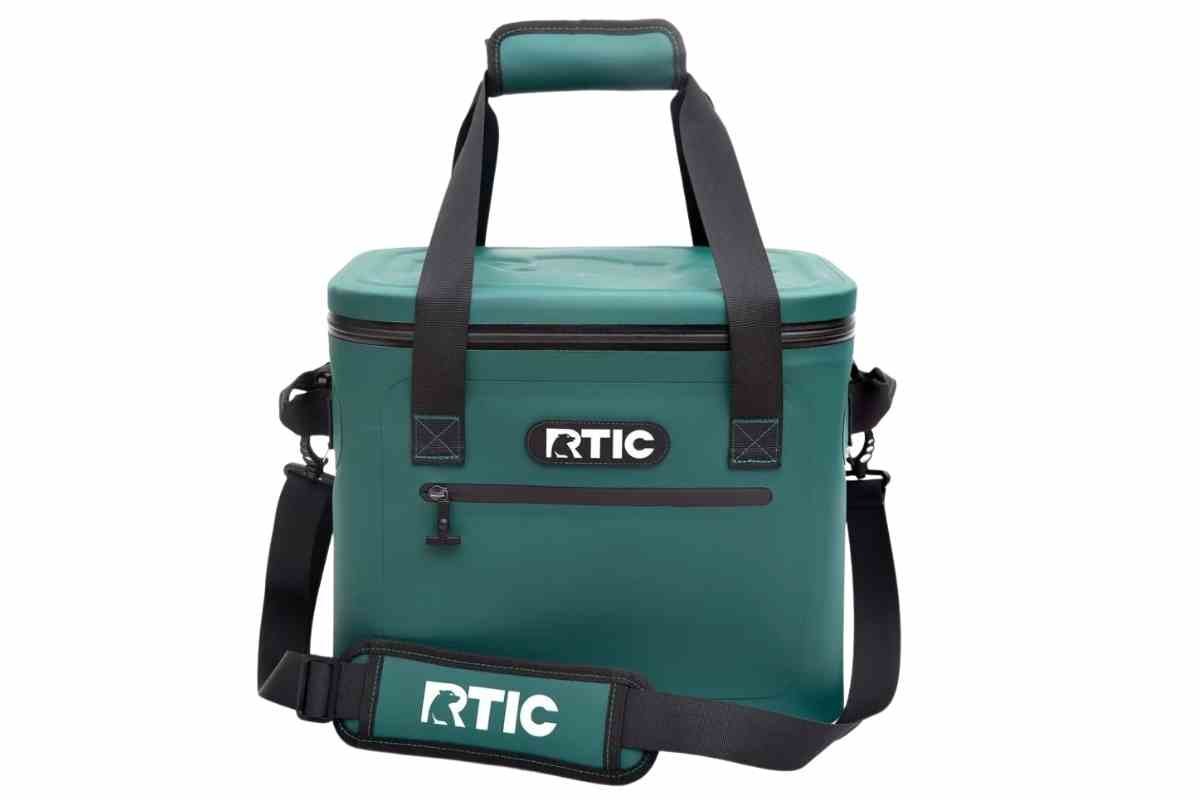
Type: Semi-rigid soft cooler
Capacity: 30 cans
Other capacities available: 12, 20, and 40 cans
What we like: Waterproof construction, good straps, watertight seal, floats in water (to a point)
What we didn't like: Decent insulation, awkward shape, durability concerns
The RTIC Soft Pack is our winner for best cooler for road trips for a few reasons. A lot of soft coolers can work for road tripping, but what sold us on the RTIC Soft Pack was its value, leak-proof design, watertight zipper, and stellar insulation, and flip-top lid. For road trips, we liked the pared-down exterior that made it easy to pack in a vehicle.
Unlike other soft coolers, the RTIC has no extra gear loops or mesh pockets to catch on luggage or seatbelts, but still plenty of handles to help readjust or pull closer. We also liked the removable shoulder strap to get us to and from the car. But what sold us? The insulation and the no-leak design.
Compare Prices Of The RTIC Soft Pack 30


-
I have to admit that we were hard pressed to pick just one soft-sided cooler as our favorite in the road trip category. All of our top picks were contenders, as were the REI Cool Haul and the Polar 24, the RTIC won us over because of its leakproof design and easy-to-pack exterior.
If you're on a road trip, you'll likely have access to stores selling ice where you can easily re-up your ice. So when it comes to the best road trip cooler, how it fits in a car, ease of access, and whether it'll keep food cold in a hot car matter. What matters less is long term ice retention because we're assuming you can get ice more easily on a road trip than say, overlanding. The RTIC Soft Pack still has stellar insulation, but is less expensive than coolers designed for days off grid.
-
Several soft coolers that we tested performed well when it came to ice retention. The REI Cool Haul technically beat the RTIC when tested in the heat — but at a cost. The REI Cool Haul (as well as the Hydro Flask Carry Out) leaked all over both a garage floor and the backseat of the tester’s truck when moved after a few hours in the sun. Neither of those coolers held up when we did the “oopsy daisy upside down” test — but the RTIC did. We took the RTIC out on picnics and days by the river, but its real test was keeping water bottles cold on a 6-hour road trip and a hot afternoon of firefighter skills testing in June.
The RTIC did well in keeping ice retained and the water bottles cold, although most of the ice had melted after dozens of times unzipping the lid and exposing the ice to heat and sun.
However, the RTIC was the only cooler that didn’t leak through to the car's back seats, which our testers appreciated. It also withstood being hauled around by one handle or another, dumped upside down (without leaking, might we add), and tossed from truck bed to truck bed as the firefighters moved through their different stations.
-
While the same concerns as the Yeti Hopper Flip zipper arose (i.e., that it wasn’t the easiest to zip and folks were worried that it would break down over time), the waterproof seal is worth a little extra effort, in our minds. If you find that your zipper is more difficult than you’d like, you can always apply some zipper lubricant, which will also help protect the zipper and increase the longevity of its effectiveness. You can do this with the front pocket zipper, too.
-
Overall, we think the RTIC Soft Pack 30 is an excellent, comparable cooler to any of the others on our list– but it didn’t match contenders like the OtterBox Trooper 20 or the Yeti Hoppers. However, the RTIC Soft Pack series is significantly more affordable than our other winners.
If you’re looking for a good, reliable, stylish, and leak-proof cooler, the RTIC Soft Pack is hard to beat — especially if your main use is for road tripping and you don't need the haul loops of more technical coolers.
Best Lunch Bag: Coleman Chiller 16-Can Soft Cooler
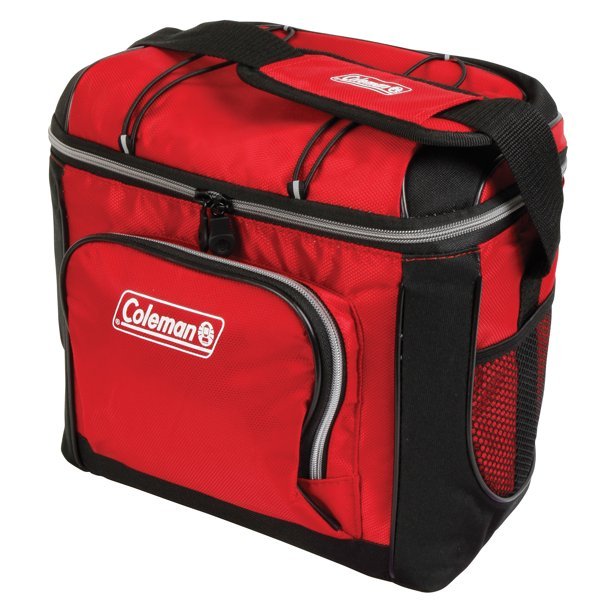
Cooler Type: Lunch Cooler
Capacity: 16 cans
Other capacities available: 18, 20 cans
What we like: Lightweight, easy to use, compact, plenty of extra pockets, inexpensive
What we didn't like: Smaller than it looks, not very insulated, less durable, not leakproof
The Coleman Chiller 16-Can Soft Cooler is the golden ticket of blue-collar lunch boxes. It’s also the greatest, cheapest, and most portable soft cooler you could ever find. While the insulation isn’t thick (or the highest quality), the zipper is nowhere near leakproof, and the size doesn’t allow you to hold much in terms of both ice and drinks compared to our other contenders, the price tag makes up for a myriad of “insufficiencies.” If you don't need to keep things cool for days — maybe just hours until lunchtime — this is the best lunch cooler you can get for the price.
View the Coleman Chiller 16-Can Soft Cooler


-
The Coleman Chiller 16-Can Soft Cooler is 10 times cheaper than our All Around winner, at just $30 compared to $300 for the Yeti Hopper M30. For that price, our testers were more than happy that their lunches and extra drinks stayed cool throughout a 12-hour shift at the local (un-air conditioned) hospital on a 90-degree day and that their makeshift charcuterie stayed cold after a 2-hour hike in Maine.
-
The webbed pouch on the roof of this Coleman soft cooler bag makes it easy to keep an ice pack up top (where a lot of cold retention is lost), while an external zippered pocket and bungees on the top are helpful for extra snacks or water bottles. A padded shoulder strap doesn’t hurt, either.
However, the hard plastic removable liner on this lunch cooler was the biggest blessing and curse amongst reviewers. Some loved the stability it gave this smaller lunch cooler and praised its easy removal for cleaning (trust us, it’s easier to clean up spilled peach cobbler from that liner than the unremovable liner of, say, the REI Cool Haul). Still, others hated that it held them back from being able to fit in Tupperware containers. What did our testers have to say about that? (Hint: it’s removable.) Take it out if you don’t like it.
Other soft coolers we tested
While we couldn’t justify giving these coolers a top seat, we couldn’t let them fall by the wayside. Here are the coolers we’d recommend if the top picks don’t seem up your alley.
IceMule Pro 23L

Cooler type: Backpack
Capacity: 23 liters (18 cans)
Other capacities available: 33 and 40 liters (24 and 36 cans)
What we like: Durable design, comfortable to carry when full, good capacity, relatively inexpensive, bungee gear hammock on exterior
What we didn't like: Learning curve for best use, not 100% leak proof, no extra pockets
The IceMule Pro is a backpack cooler constructed from 1000-denier, waterproof and ripstop vinyl that sandwiches a good layer of insulation and room to fill with air. Why include an air valve, you ask? Essentially, colder air (cooled down by the ice inside) will keep the cold insulated longer, so the air can work in your favor on hot days. If you’re into paddlesports, this also keeps the IceMule Pro afloat, even if it tumbles overboard full of beverages and ice. It’s the only soft pack cooler in our lineup with such a feature, but we found it did come in handy and seemed to help retain even more cold.
Other testers who brought the IceMule Pro on paddling trips were pleased with the ice retention (second only to the Yeti M30 and the OtterBox Trooper), waterproofness, comfort, and flotation abilities.
Compare Prices Of The Icemule Pro

Cooler Type: Insulated cooler backpack
Capacity: 25 quarts
What we like: Easy roll-top, padded shoulder straps and back, welded seams, abrasion- and puncture-resistant TPU coating, flat base
What we didn't like: Loss of ice retention at roll-top due to lack of insulation
TheEngel Roll Top High Performance Backpack Cooler was a close runner-up in our Best Soft Cooler Backpack competition — however, we couldn’t look past how the roll-top allowed so much heat through to melt the top contents, despite the beefy insulation at the base and four walls.
Although it performed well in the bottom and middle layers for keeping frozen items cold, we couldn’t ignore how much ice was lost at the roll-top for a $200 cooler.
Read the full review of the Engel Roll Top Backpack Cooler here.
View the Engel Roll Top High Performance Backpack Cooler

Cooler Type: Insulated cooler bag/tote
Capacity: 20 L
Other capacities available: 12L
What we like: Ice retention, easy zipper, front pocket, longer handles
What we didn't like: Leaks
The Hydro Flask Carry Out 20L was a close runner-up in our Best Soft Cooler Bag for Picnics and the Beach competition — however, we couldn’t look past how much the cooler bag leaked during our ice retention test. Although it performed well with retention, we were surprised at how much of the ice water leaked out from the cooler overnight.
This cooler did sport one of the easiest zippers to use out of any that we tested (albeit not a leakproof zipper). We loved the longer handles and rounded edges that made it far more comfortable to carry this soft cooler around the park or across the parking lot. However, we couldn’t give it a top pick with that much leakage.
View The Hydro Flask Carry Out 20 L

Cooler Type: Cooler Bag/Tote
Capacity: 24 cans
Other capacities available: 6, 12, 48 cans
What we like: Ice retention, durable exterior, wide mouth, external pock
What we didn't like: Not leakproof
We didn’t receive our tester samples of the Polar Bear Cooler series until the end of our testing/writing process. Hence, we reserve the right to update our opinions after additional testing.
However, from an initial ice retention test, the Polar Bear Cooler 24 series did okay with holding onto ice in direct sunlight and shade — but it didn’t blow us away. While we wouldn’t say to throw out this option altogether, as it seems to perform well for a mid-range option, we couldn’t give it a top spot, either.
What we did appreciate was the wide mouth, which made loading ice and cans exceptionally easy, and gave us great access to finding exactly what we needed throughout the day. The handles are tough, the shoulder strap is padded, and the metal hooks that attach the wide-open mouth ends are heavy-duty — for a good cooler for picnics, day trips, and days by the water without the pricey frills, we would certainly recommend the Polar Bear 24 Soft Cooler.
View The Polar Bear Nylon Soft Cooler Series 24

Hard coolers have longer ice retention, but are heavier, take up more room, are less portable, and more expensive. They’re ideal for people living in an adventure vehicle or going on long camping or rafting trips — but soft coolers are a better option for most trips.
Soft coolers vs. Hard coolers
What’s the deal with coolers these days? Options, my friends. Instead of just the old ammo can or a styrofoam box, you now have thousands of options. One of the core decisions to make, however, is whether to get a hard-sided cooler or a soft-sided cooler.
What makes one type of cooler better than the other? A lot comes down to personal preference. However, there are a few critical factors between hard and soft sided coolers. If you’re looking for a multi-day adventure, heading out on a boat, or road-tripping, we’d recommend a hard cooler. They are far more durable, hold ice longer, and have larger sizes available to fit more snacks.
If you’re looking for a cooler for a day at the lake, to throw in the car on your way to the park, for an overnight or weekend camping trip, or just to bring drinks to the crag, then a soft cooler might be a better option! They’re also easier to store since they can (usually) pack down.
Insulation and Ice Retention
Because hard coolers are often heavier, this means that they also have more insulation, making them better at keeping things cold and holding ice for longer. If ice retention and insulation is a top priority, a hard cooler is a better choice. But if portability, weight, and affordability are more important, a soft cooler will be a great option.
Capacity
Both hard and soft coolers come in a variety of sizes. However, because of the rigidity of hard coolers, if you need something particularly large you probably won’t find a soft cooler in that size, largely because it wouldn’t be able to support the weight. So if you need a particularly high capacity cooler, a hard cooler may be your only or best option. But if you don’t need something huge, you’ll find a wide variety of options for both hard and soft coolers.
Portability
Soft coolers are designed to be easier to tote around (pun intended), with some models sporting backpack straps, cross-body straps, adjustable handles, and lightweight materials. While hard coolers also come with great handles, they are generally bulkier and heavier than their softer counterparts, making them more challenging to pick up and bring along. Aside from a hardsided cooler with wheels like the Rovr Rollr cooler, we find in general a soft cooler is much more portable than most hardsided coolers.
Weight
As we said above, hard coolers are made from heavier (and heavy-duty) materials, which generally weigh more than the fabrics used to make soft coolers. Rotomolded plastic versus a nylon or vinyl exterior? It’s a no-brainer — soft coolers win in the weight category. If weight is less of an issue (say, with rafting or on a motorized vehicle) then hard-coolers are the way to go for more capacity and better retention. However, if carrying heavy weight over longer distances isn’t really an option, soft coolers will become your best friend.
Functionality
Soft coolers are afforded a much more versatile function due to the two facts above — their lighter weight and easier portability. Soft coolers are generally smaller, easier to store in a boat, more fitting to tuck in the back of a car, and more fitting to pack up for a day in the park or at the beach. It’s much more effective for throwing a few sandwiches and drinks in for that after-hike respite or packing extra snacks for a mid-afternoon concert.
Price
Soft coolers, on average, are more affordable than hard coolers. For example, if you want a Yeti Cooler, the soft-sided options we recommend will be less expensive than the hardsided Yeti Tundra or Yeti Roadie that are our winners in the Best Camping Coolers guide.
But if price is the main reason you're thinking about opting for a soft sided cooler instead of a hard cooler, check out the Coleman Xtreme cooler recommended in our Best Camping Coolers guide. It can hold ice up to 5 days and costs the same (or less!) as most of the soft coolers in this guide.
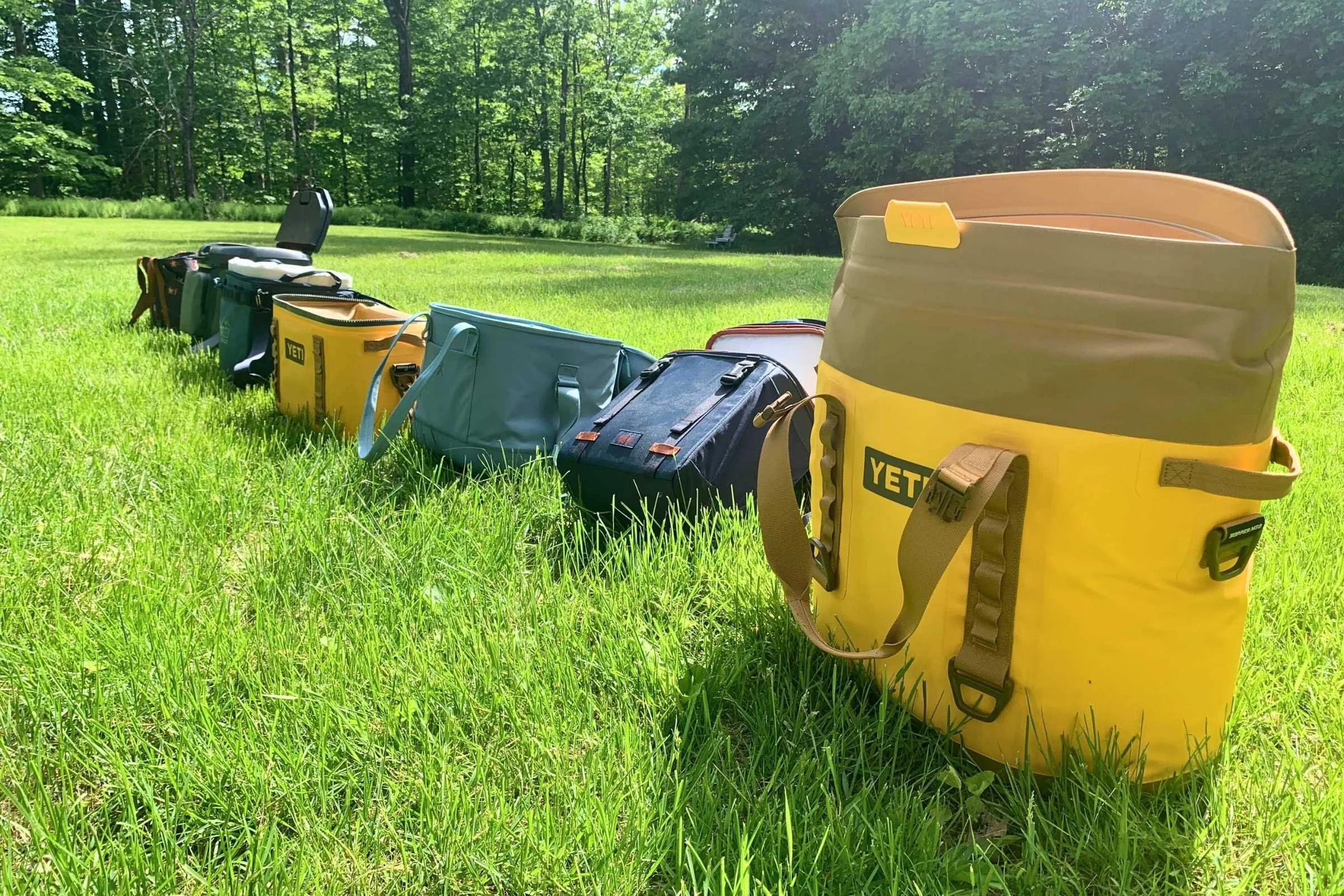
Some of the soft-sided coolers we tested side-by-side in Western Maine.
How To Choose a Soft Cooler
Which soft cooler keeps ice the longest?
This one was a close call. The Yeti Hopper M30 was our winner for best/longest ice retention, with the REI Cool Haul and REI Cool Trail Split Pack close on its heels. However, both REI options had a little water leakage, while the Yeti Hopper M30 held watertight.
What makes a “soft” cooler?
Soft coolers are made from “softer” materials such as vinyl or nylon, as opposed to “harder” materials such as rotomolded plastic or metal. The insulation might not be as beefy, and the exterior might not be as heavy-duty as their hard-sided counterparts. However, soft coolers are no slouch regarding toughness — they can still be leakproof, waterproof, and do it all while weighing a fraction of what their boxy, beefy cousins weigh.
Do I need to pre-chill my cooler?
Not necessarily, but it can’t hurt! Pre-chilling means cooling down your cooler before packing it with ice and food. Your cooler will be the most effective when it’s already cooled down, which means your food and beverages will last longer. (Think of it like warming up your car in the middle of winter — if you get in immediately, your seats and steering wheel will still be cold. But if you let it run for a few minutes, the heat will warm up the interior, and you’ll have a much more enjoyable drive.)
If your cooler has been in a hot garage, in the sun, or it’s just plain hot outside, hose it down with cold water, then throw some extra frozen veggies or ice packs into it before you load the cooler up with ice and your picnic supplies. If you’re going to be out for several days and need your ice to last as long as possible, try putting ice packs in the night before you load it up.
What size cooler do I need?
It all comes down to your planning — how many people, for how many days, and how many meals? Think like this: if 1 quart equals roughly 0.75 cans, a 12-quart cooler will hold 9 sodas. But that’s without room for ice! Many cooler company websites will measure the number of cans each cooler can hold, with a 2:1 ice ratio.
For the weekend warrior, a 30-50 liter cooler will be large enough for all your snacks and drinks, depending on the number of people. (The author and 3 friends will bring the Yeti M30 soft cooler filled with 25-30 beers for an overnight river trip, if that gives you any context.) But if you have a large family (the author comes from a family of 6) and want to go on a week-long camping trip, you may have to start looking in the 60-100 liter range. (Look at the hard-sided cooler story for those tips!) However, a road-tripper might want something more in the 10-20 liter range to store easily but keep snacks and drinks readily available.
What is the intended use of the cooler?
Think about what environment you’ll mostly be using your soft cooler in: on road trips, camping, for boating or other water sports? Will you be in hot weather where you need to have good insulation, or is packability more important? Consider durability as well, based on your intended use. A cooler for road trips will generally not need to be as durable as one used for fishing, rafting, or camping.
Is the soft cooler compatible with ice packs or is it better suited for loose ice?
You can use both loose ice or ice packs in a soft cooler. Loose ice can often help keep things colder, but once it melts it will leave behind water whereas ice packs will not. If you plan to use loose ice, make sure the cooler you choose has good waterproofing and zippers or other closures.
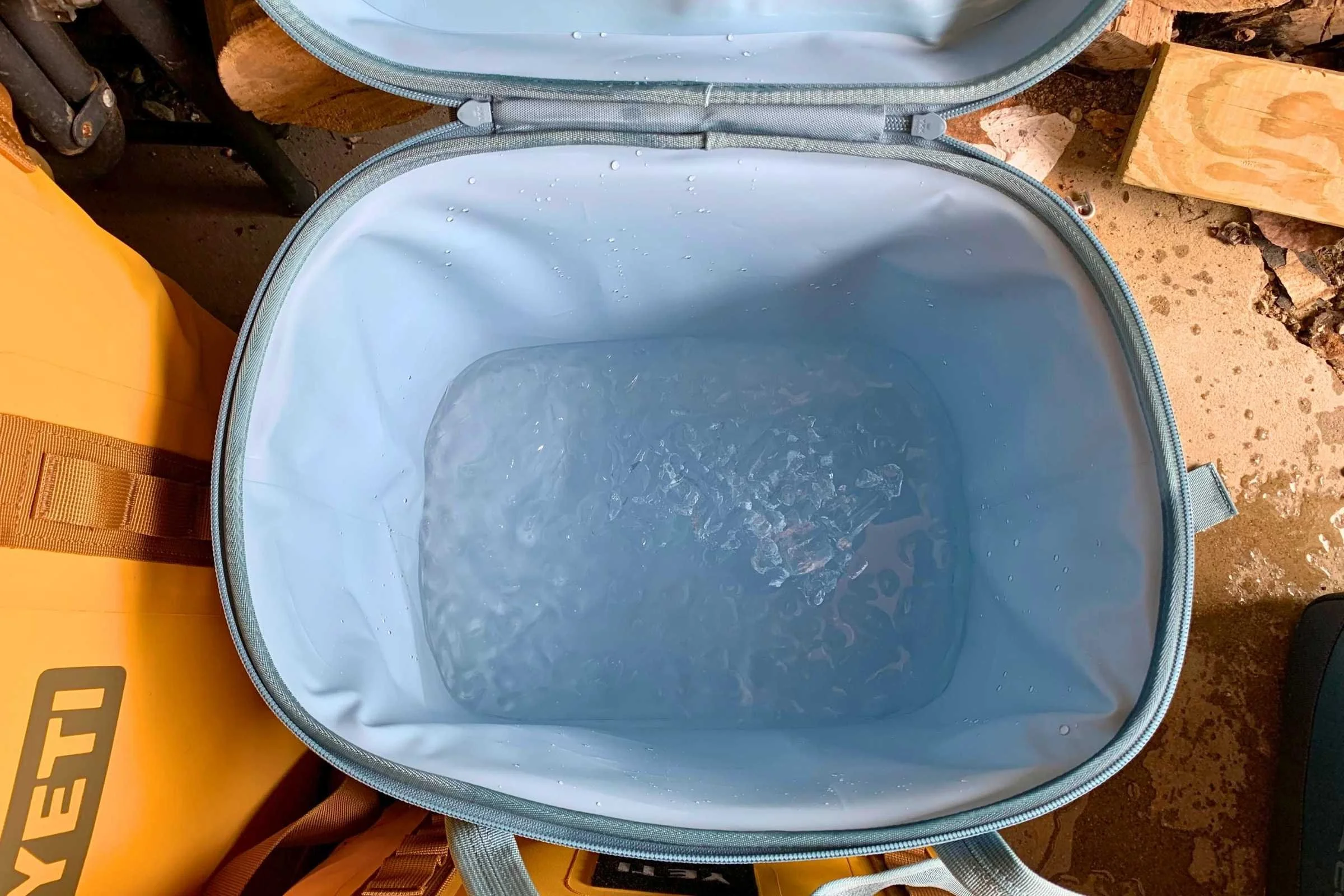
The Hydro Flask Carry Out cooler 20 hours into our ice retention test.
What to look for in a soft cooler
Price
This is a no-brainer. While our most expensive tested cooler rang in at $350, there were features about it that stood apart from the $30 lunchbox-esque cooler. However, we wanted to find affordable options that still hold up to our durability and ice retention tests without blowing your budget for the month.
Available Sizes/Capacities
While we couldn’t test every size of every soft cooler brand, we aimed for the middle size or the larger size in every soft cooler that we could. Our top picks include products available in a range of sizes to fit your group size, activity, or available space.
Durability
If you plan to pay top dollar for a soft cooler, you expect a high-quality, durable product. We wanted to ensure that all our picks — from the budget pick to our favorite pick — were made for rugged picnics and harried last-minute packing jobs. In that regard, we sought and tested coolers with abrasion-resistant materials like high-denier nylon or waterproof Hypalon. Reinforced straps, burly zippers, and strong handles were also huge contenders in winning our durability category.
Capacity
Arguably the most important aspect of a soft cooler (besides ice retention) is its capacity. Nearly every other feature is determined by this desired capacity, including weight, design, pockets, etc. Our tested soft coolers ranged from a dozen to thirty cans-worth capacity, with an average of 18. However, the amount of ice you want to use limits the number of beverages or food you want to pack, as well — take this into account when you’re looking for sizes. When in doubt, size up. The extra room for ice will serve you well on sweltering days.
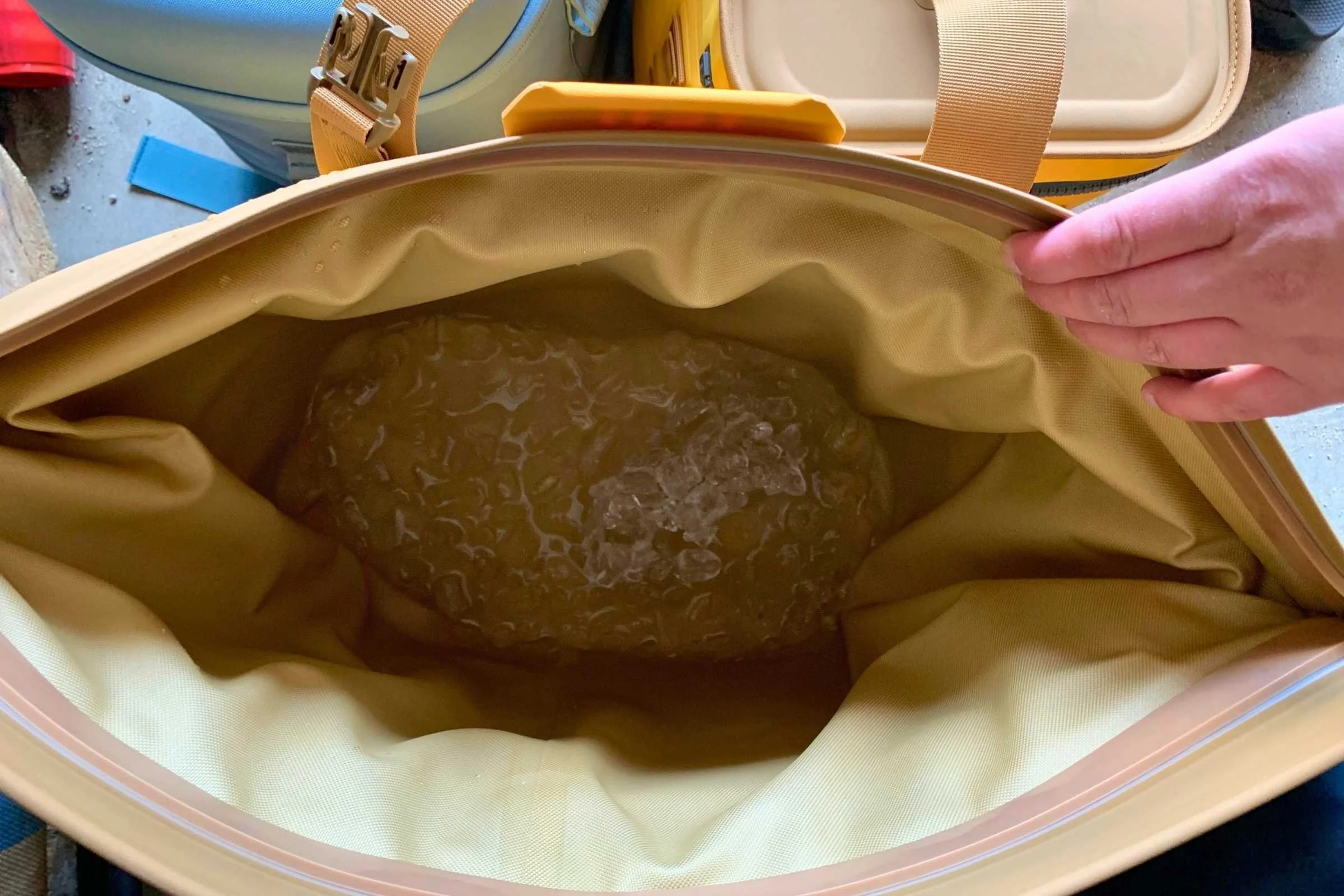
Yeti Hopper M30 cooler bag 20 hours into our ice retention test.
Ice Retention/Insulation
What’s the point of a cooler? To keep your beverages and food cold! If you’re looking for a soft cooler, you’re likely looking for both convenience and resilience in one product. Most brands showcase their ice retention rates (10 hours in direct sunlight at 80 degrees, for example) in their product descriptions. We’ve included the manufacturer’s ice retention claims and our own ice retention trial results in the table at the beginning of this article.
Ice retention comes down to the quality and the amount of insulation in the design of your soft cooler. In essence, you’re paying for the quality when you look at that price tag (hopefully — but that’s why we tested and reviewed our winners so thoroughly!). The better the insulation, the longer your ice should last, and the colder your contents should stay.
Check out these keep-it-cold tips from Yeti for a great guide on maximizing your ice retention.

Rafting with the Yeti Hopper cooler bag, which benefits from being partially collapsible so takes up less space in the boat after you’ve finished your drinks inside.
Weight
Soft coolers are meant to be the lighter-weight, easier-to-tote siblings of traditional hard coolers, so it stands to reason that weight plays a big factor in your purchasing decisions. If you’re looking to carry your cooler in on your hike, the weight is an even bigger factor — your ice and food will already weigh a decent amount, so you don’t want your cooler to weigh you down.
Take into account how much you’re willing to carry to the park, the beach, or the lake a couple of miles down the trail — that may influence your decision to hit “Buy Now.”
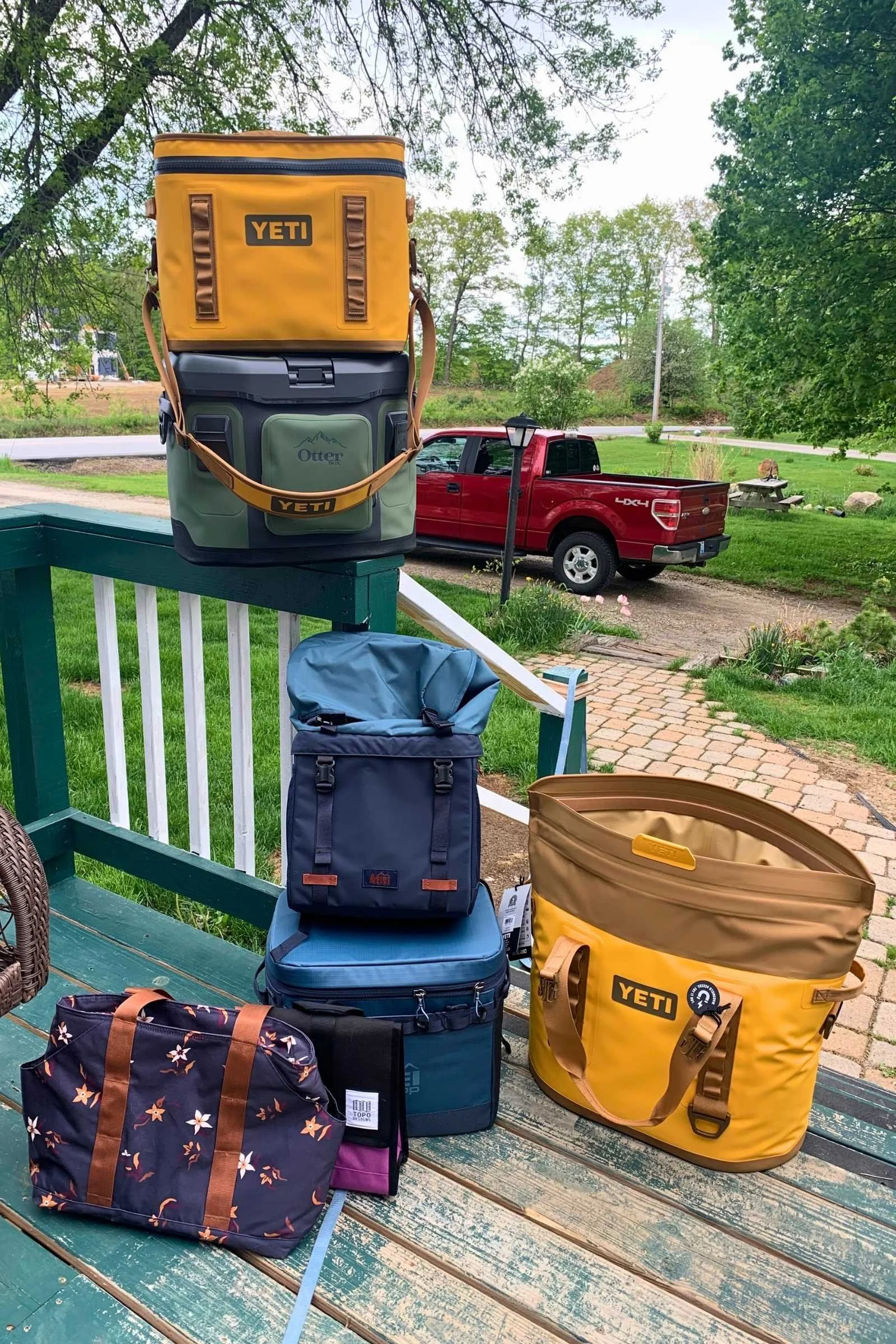
We tested soft coolers side-by-side on road trips, canoe trips, picnics, and more from the Atlantic to the Pacific.
Strap Design
Nearly every cooler we tested featured removable straps for carrying cross-body and handles for shorter distances. However, a few of our models — like the Hydro Flask Carry Out cooler bag — had adjustable straps, although we wouldn’t consider them as easily removable as the detachable clips on the REI Cool Haul, the OtterBox Trooper, or the Yeti Hoppers.
Others, like the REI Cool Trail Split Pack, are designed to be worn like a backpack and have permanent straps. It’s personal preference, depending on what you like, but we liked the ability to completely remove the cross-body straps (like the Yetis featured) and even tuck in the longer handles (like the REI Cool Haul flip-top used).
Pockets
If there’s one thing we love, it’s storage options; pockets reign supreme in the soft cooler department. Several of the best soft coolers in this article feature side pockets and front pockets for cell phone and wallet storage, strap storage, or even a change of clothes (like the REI Cool Trail Split). While pockets may not be as important as ice retention or capacity, they’re pretty darn convenient.
Water Resistance
Most soft coolers will not be as waterproof as hard coolers, but they should still be water resistant. While the inside of most coolers will have a waterproof lining, the outside materials will vary. One that is water resistant will often be more durable and easier to clean.
How we researched and tested
We tested soft coolers over the past 4 years in the following locations:
Rafting the Sago River in Maine
Kayaking and picnics at lakes in Maine
Hiking through the White Mountains of New Hampshire
Road tripping across the Mojave desert and Las Vegas
Camping for a month in the eastern Sierra without a working refrigerator
Numerous hiking trips, kayaking and canoeing trips, and day trips in Yosemite and the surrounding area
Monthly trips to our favorite ice cream shop across Los Angeles sitting in hours of traffic
Our Testing Process
Rigorous field testing from coast to coast
Testing Locations
- Alaska to Colorado river trips
- Maine's Saco River & York Beach
- 90°F+ direct sunlight conditions
- Pinnacles & Mojave National Parks
- Road trips across Eastern seaboard
- White Mountains, New Hampshire
What We Test
- Ice retention in controlled conditions
- Leakproof performance (upside-down test)
- Zipper durability with sand & grit
- Portability & strap comfort
- Material abrasion resistance
- Real-world capacity & usability
We also ran these "lab" style tests:
Ice retention
We put all of our contenders to the test with an ice retention test — the same temperature, the same amount of ice, over the same amount of hours. While we understood that environments might vary, we wanted to pit the manufacturer’s claims against our experience. In most cases, the claims hold up, but see for yourself what our conditions and results were in the table above.

Loading up the Yeti Hopper Flip soft cooler in the back of a truck with the canoe and kayaks outside Fryeburg, ME.
Leakproof
This might not be hugely important for an afternoon picnic, but for an all-day affair or a road trip, making sure your cooler doesn’t leak is a big deal. Some of our coolers performed extraordinarily, even in the upside-down-shake test. Some of our coolers leaked through just sitting on the ground, and others leaked when you tipped them on their sides. We tested coolers in various positions to see which ones stayed locked tight and which ones dribbled out.
Portability
Soft coolers are meant for easy carrying! We asked testers of different body sizes, shapes, and strengths and energy levels to test how easy it was to use the top and side handles and shoulder strap(s). We looked for ergonomic shapes and lighter weights to make transport significantly easier. After all, we love the hard-sided cooler cousins, but soft coolers were meant for on-the-go adventures.
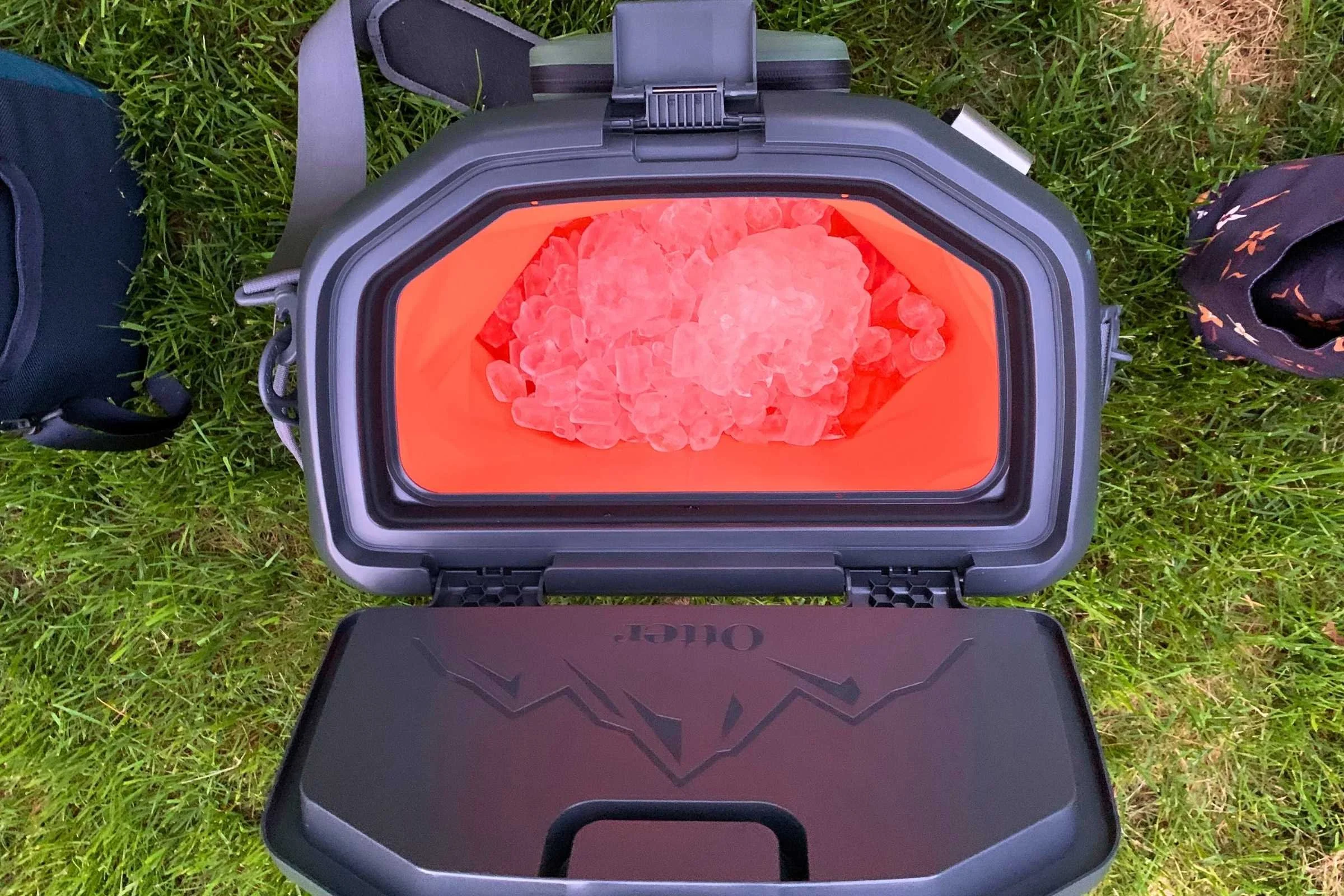
The OtterBox Trooper cooler 20 hours into the ice retention test.
FAQ
-
Most soft coolers keep ice for 8-24 hours depending on insulation quality, conditions, and usage. High-end models like the Yeti Hopper series can maintain ice for up to 3 days in ideal conditions, while budget options like the Coleman Chiller typically provide 8-12 hours of cooling. Ice retention varies significantly based on ambient temperature, direct sunlight exposure, and how frequently you open the cooler.
-
Yes, most soft coolers are easy to clean with removable waterproof liners that can be rinsed or wiped down. The exterior fabric varies by model - some have water-resistant coatings that wipe clean easily, while others may require gentle scrubbing. Remove all contents, rinse with warm soapy water, and air dry completely before storage to prevent mold and odors.
-
Use a 2:1 ice-to-contents ratio and layer ice throughout the cooler for maximum efficiency. Start with a base layer of ice, add pre-chilled items, then top with more ice. Pre-chill the cooler for 2-4 hours before packing, and fill empty spaces with towels or additional ice to minimize warm air pockets that accelerate melting.
-
Yes, soft coolers have weight limits typically ranging from 30-50 pounds when fully loaded, depending on the model's construction and strap design. Check manufacturer specifications before packing - overloading can damage zippers, seams, or straps. Backpack-style coolers like the IceMule Pro generally handle more weight than tote-style models due to better weight distribution.
-
Clean thoroughly and air dry completely before storage to prevent mold, mildew, and odors. Store in a cool, dry place with zippers fully closed to keep dust and debris out. For collapsible models, fold according to manufacturer instructions to prevent creasing or damage to insulation materials.
-
Yes, soft cooler insulation works both ways - most can keep hot foods warm for 2-4 hours. However, avoid placing extremely hot items (over 140°F) directly against interior walls as this may damage waterproof linings or insulation materials. Check manufacturer guidelines for maximum temperature recommendations to prevent material damage.
-
Follow the 2:1 ice-to-contents ratio for optimal performance - use twice as much ice as food/drinks by volume. For a 30-can cooler, aim for ice to fill about 60-65% of the space. Block ice lasts longer than cubed ice, but cubed ice chills contents faster initially. Combine both types for best results on longer trips.
-
No, dry ice should never be used in soft coolers as it can damage fabric materials and insulation with its -109°F temperature. Soft coolers lack the ventilation systems needed for safe dry ice use. Stick to regular ice or reusable ice packs designed for soft cooler temperatures and materials.
-
Choose models with waterproof zippers (like Yeti's HydroLok or RTIC's welded zippers) rather than water-resistant ones. Avoid overpacking which can stress seams and zippers. Test new coolers at home before trips by filling with water to identify potential leak points. Apply zipper lubricant regularly to maintain proper sealing on high-end models.
What can you use your soft cooler for

The rigidity of the boxy OtterBox Trooper cooler made it well suited for using on a boat. Here, we tested it at the worksite.
Soft coolers are versatile and can be used for a lot of things outdoors and in everyday life. Here's just a few ways that we use soft coolers:
1. Picnics: Soft coolers keep your food and beverages chilled during picnics in parks, beaches, forest, or mountains.
2. Camping: They are lightweight and easy to transport, making them perfect for camping trips where space and weight are limited.
3. Hiking and backpacking: Some of the soft coolers we considered are designed as backpacks. These are designed to make carrying them on hiking trails a little easier. Ideally, you'd find a friend to carry a separate backpack with the gear.
4. Tailgating: Soft coolers are great for keeping beverages cold at tailgate parties before sporting events or concerts.
5. Beach trips: Their compact size and portability make soft coolers a good option for carrying to the beach and keeping drinks and snacks cool. This is especially true if you have to park and walk a few blocks to the beach, as is common in more popular beachside towns.
6. Fishing: Soft coolers are often used by anglers to keep caught fish fresh. Just be sure to clean it out afterwards.
7. Road trips: They fit easily in the trunk of a car and can be used to store drinks and snacks for long road trips.
8. Boating: Soft coolers are often used on boats to keep drinks and perishable items cold while out on the water.
9. Lunches for work or school: Many soft coolers are designed to fit lunch containers, making them perfect for keeping meals cold during the workday or at school.
10. Outdoor events: Soft coolers can be used at outdoor events such as barbecues, festivals, or concerts to keep food and drinks cool for extended periods.
11. Grocery runs: Many of us who live in small mountain towns will do grocery runs in bigger cities that may be hours away from home base. We'll store ice cream and other must-keep-cold items in our soft cooler for the drive home. We're often doing several chores in the big city, too, like doctor's appointments or dealing with the local government. The soft cooler comes in handy for when we start with grocery shopping and our other chores take longer than we realized.
About the Author/Why You Should Trust Us

The author guiding a rafting trip in Haines, Alaska.
There aren’t many things that I would claim to be great at, but bringing along the snacks and drinks for any adventure is one I’ll ecstatically claim. I started with extra homemade cookies tossed into a backpack for the trail or crag, eventually upgraded to hard coolers on rafts, and then packed for multi-day river and cross-continent road trips. I’ve been a backpacking, rock climbing, hiking, and rafting guide in Alaska and Colorado; packing food and beverages is second nature. You name it, and I’ve probably tried to keep it cold and bring it out into the wilderness — from steaks to cheesecakes to growlers of beer.
Transitioning from hard-sided coolers to soft-sided coolers was a no-brainer, especially in the realm of weekend-warrior adventurers, as I turned back to once I left the guiding industry. They’re more portable, lighter, and still get the job done while taking up a fraction of the space compared to hard-sided coolers. Read: soft-sided coolers made it easier to toss charcuterie ingredients and a few beers into the truck and take off after work for a quick hike, climb, or paddle session. But do they stand the test of long weekend camping trips and drives along the Eastern seaboard? That’s what I struck out to uncover.
My gear expertise stems from 6 years of gear reviews for Backpacker Magazine, 8 years of guiding, 29 years of camping adventures, and many gear-head friends. In addition, I’ve written outdoor lifestyle pieces for NRS’s Duct Tape Diaries, REI’s Uncommon Path Magazine, and Powder 7 Ski Shop’s Lift Line Blog. (For additional publications and upcoming articles, check out my website.)
Let it be known: no one in my family (including myself) is sponsored, an ambassador, or an employee of any of the companies mentioned here. Our reviews are unbiased, and we do this to help you find the best product for the price.
You can read all of Josette's articles on her author page.
Sources